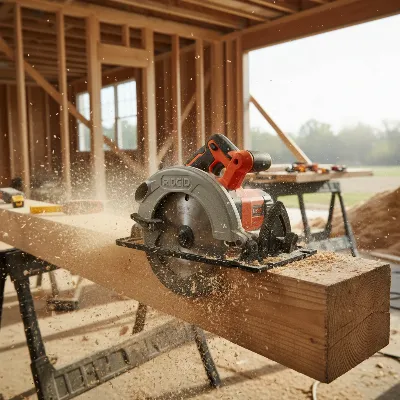
Few things are more frustrating in woodworking than making what you believe to be a perfect cut, only to find your circular saw has wandered off course, leaving you with a crooked line. This common issue can sabotage projects, waste material, and test the patience of even seasoned DIYers. Whether you’re cutting plywood for cabinetry, ripping lumber for framing, or crosscutting a board for a shelf, a straight cut is foundational to a professional finish. This comprehensive guide will delve into the most common culprits behind an unruly circular saw and provide clear, step-by-step DIY solutions to get your cuts back on track, ensuring accuracy and efficiency in your workshop.
Common Causes for Crooked Circular Saw Cuts
Understanding why your circular saw deviates from a straight line is the first step toward fixing the problem. Often, it’s not a single issue but a combination of factors. Identifying these will allow you to diagnose and resolve the specific challenges hindering your precision.
A primary suspect is a dull or damaged blade. Over time, saw teeth become blunt, chipped, or even missing, forcing the saw to work harder, which can lead to burning, resistance, and a tendency for the blade to wander. A bent or warped blade, perhaps from impact or overheating, will inherently produce an inaccurate cut as it struggles to maintain a consistent plane. Additionally, accumulated sap, resin, or sawdust on the blade can cause friction and bind the blade, deflecting it from its path.
Another frequent cause is a misaligned base plate, also known as the shoe. The base plate must be perfectly square to the blade at a 0-degree (90-degree) bevel setting for straight cuts. If the plate is even slightly off, the saw will “walk” away from a guide or veer from your intended line, resulting in an angled or curved cut. This misalignment can be a manufacturing defect, or it can develop over time due to heavy use or accidental drops.
Loose adjustments also play a significant role. Circular saws have mechanisms to set the cutting depth and bevel angle. If these locking levers or knobs are not securely tightened, the blade’s position relative to the base plate can shift mid-cut, leading to inconsistencies. An improperly set cutting depth, either too shallow or excessively deep, can also affect control and contribute to wandering.
Your cutting technique can significantly impact accuracy. Forcing the saw through material, applying uneven pressure, or attempting to cut too quickly can cause the blade to deflect. Lifting the back of the saw’s shoe even slightly, failing to keep the base plate flat against the workpiece, or maintaining an awkward body position can all compromise a straight line.
Finally, inadequate workpiece support and the absence of a proper cutting guide are common pitfalls. If your material sags, shifts, or isn’t clamped securely, the saw’s path can easily be influenced. Relying solely on freehand cutting without a straight edge or jig makes it incredibly challenging, if not impossible, to achieve consistently straight results, especially on longer cuts.
Step-by-Step Solutions to Achieve Straight Cuts
Now that we’ve identified the common culprits, let’s explore the actionable steps you can take to bring your circular saw back into alignment and ensure consistently straight cuts. Remember to always prioritize safety by disconnecting the saw from its power source before performing any inspections or adjustments.
1. Blade Inspection and Replacement
The blade is the business end of your saw, and its condition is paramount for straight cuts.
- Check Blade Condition: Carefully inspect the blade for signs of wear. Look for dull, chipped, or missing carbide teeth. A blade that has been overheated might show discoloration or even a subtle warp. Dull blades burn wood and deflect easily. If you notice any significant damage or excessive dullness, it’s time for a replacement.
- Clean the Blade: Resins, sap, and sawdust can build up on the blade, increasing friction and making it prone to binding. Remove the blade and clean it thoroughly with a blade cleaner or a mild solvent and a stiff brush. Ensure it’s completely dry before reinstallation.
- Ensure Proper Installation: When reinstalling, make sure the blade is seated flat against the inner flange and tightened securely. Crucially, confirm the teeth are facing the correct direction, usually indicated by an arrow on the blade itself and the saw’s housing. A backward blade will not cut effectively and can be dangerous.
- Choose the Right Blade: Using the correct blade for your material and type of cut is vital. A general-purpose blade might suffice for many tasks, but specialized blades (e.g., thin kerf for less material removal, higher tooth count for smoother cuts on plywood) can improve performance and accuracy.
|
Our Picks for the Best Circular Saw in 2026
As an Amazon Associate I earn from qualifying purchases.
|
||
| Num | Product | Action |
|---|---|---|
| 1 | RIDGID 18V Cordless 6 1/2 in. Circular Saw (Tool Only) |

|
| 2 | Mini Circular Saw, 4Amp 3500RPM Corded Compact Saw with 4-1/2" 24T TCT Blades, Laser Guide, Rip Guide, Vacuum Adapter and Blade Wrench, Max Cutting Depth 1-11/16"(90°), 1-1/8"(45°) |
|
| 3 | Seesii Mini Circular Saw with Laser Guide,4.8A 4000 RPM Compact Corded Circular Saw with Rip Guide,3 Blades (4-1/2") for Wood,Soft Metal,Tile,Plastic Cutting,Max Cut Depth 1-11/16"(90°),1-1/8" (45°) |
|
| 4 | RIDGID 18V SUBCOMPACT BRUSHLESS Cordless 6-1/2 in. Circular Saw Tool ONLY R8656B |
|
| 5 | Makita 5477NB 7-1/4" Hypoid Saw |
|
| 6 | Cordless Circular Saw 6-1/2" for Makita 18V Battery (Not Inclued), 4500RPM Power Circular Saws w/Laser Guide, 0-45° Bevel Capability, Max 2-3/16" Depth, Electric Saw for Wood Plastic |
|
| 7 | RYOBI Circular Saw CSB125 13-Amp 7-1/4 in. Electric (Renewed) |
|
| 8 | Ryobi 14 Amp 7-1/4" Adjustable Electric Circular Saw w/Exactline Laser | CSB135L |
|
| 9 | Ridgid ZRR32104 THRUCOOL 7-1/4 in. Worm Drive Saw (Renewed) |
|
| 10 | Makita 5377MG 7-1/4" Magnesium Hypoid Saw |
|
> “A sharp, clean blade is the single most important factor for achieving a straight cut. Never underestimate the impact of a fresh edge.” – Mark Johnson, Master Carpenter
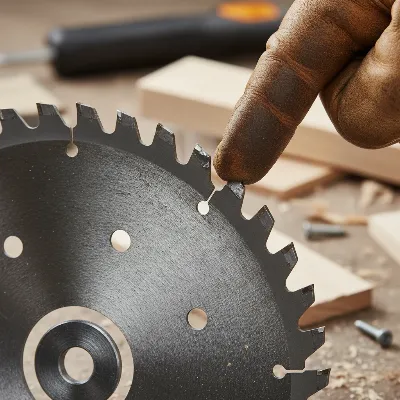 A close-up of a circular saw blade being inspected for dullness and damage
2. Base Plate (Shoe) Alignment
A misaligned base plate is a sneaky culprit that can consistently throw off your cuts.
- Safety First: Unplug your corded circular saw or remove the battery from your cordless model.
- Check for Squareness: Set your saw’s bevel adjustment to 0 degrees (90 degrees to the base). Place a reliable carpenter’s square or a machinist’s square firmly against the base plate and then against the side of the blade, ensuring the square is between the blade’s teeth for an accurate reading. There should be no gap between the square and the blade or the base plate.
- Adjustment (if applicable): Many circular saws, especially higher-quality models, have adjustment screws that allow you to fine-tune the base plate’s squareness to the blade. Consult your saw’s owner’s manual for specific instructions on how to access and adjust these screws. It usually involves loosening a few screws, adjusting the plate, and then retightening. If your saw lacks this adjustment or the base plate is severely warped, it may be a defect that requires professional repair or replacement.
3. Securing Saw Adjustments
Loose depth and bevel settings are common reasons for unexpected deviations.
- Depth Lock: Before making a cut, ensure the depth adjustment lever is firmly locked. For optimal control and safety, set the blade depth so that the teeth extend approximately 1/8 to 1/4 inch (about the thickness of one saw tooth) below the material you are cutting. This minimizes blade exposure and reduces kickback risk while providing efficient cutting action.
- Bevel Lock: Unless you are intentionally making an angled cut, ensure your bevel adjustment is locked securely at the 0-degree (90-degree) position. Any looseness here will allow the blade to tilt during a cut, resulting in an unintended bevel.
4. Improve Cutting Technique
Even with a perfectly tuned saw, poor technique can lead to crooked cuts.
- Maintain Steady Pressure: Let the saw’s motor do the work. Apply steady, consistent forward pressure, allowing the blade to cut at its own pace. Forcing the saw or pushing too hard will cause it to bind, overheat, and veer off course.
- Keep Base Plate Flat: Throughout the entire cut, keep the saw’s base plate flat and firmly in contact with the workpiece. Avoid lifting the saw’s back end, which is a common mistake that causes the blade to rise and produce an uneven cut.
- Consistent Speed: Maintain an even feed rate. Erratic speed changes can lead to inconsistent cutting quality and accuracy.
- Two-Hand Grip: Always use both hands to operate your circular saw. One hand on the main handle and the other on the auxiliary front handle provides maximum control and stability.
- Clear Path: If you’re using a corded saw, ensure the power cord is clear of your cutting path and won’t snag or pull the saw off line. Plan your body position so you can comfortably follow through with the cut without stretching or awkward movements.
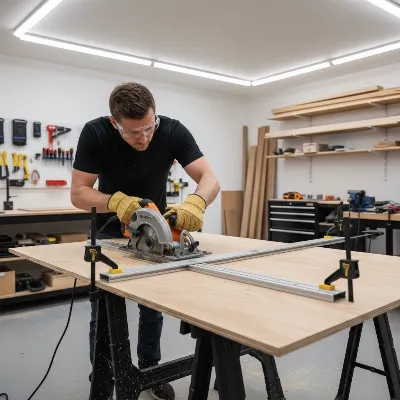 A DIYer demonstrating proper circular saw cutting technique with a straight edge guide
5. Utilize Cutting Guides
For truly straight and accurate cuts, especially on longer materials, a cutting guide is indispensable.
- Straight Edge Guide: The simplest and most effective method. Clamp a perfectly straight board (like a factory-edge piece of plywood or a metal ruler) to your workpiece. Position it so the saw’s base plate rides snugly against its edge. Remember to account for the blade’s offset (the distance from the edge of your base plate to the blade) when setting your guide.
- Rip Fence: Many circular saws come with a small rip fence that attaches to the base plate. This is excellent for making consistent rip cuts parallel to the edge of a board.
- Speed Square: For shorter crosscuts, a speed square can serve as a temporary, effective guide. Simply hold it firmly against the edge of your material and run the saw’s base plate along its edge.
- DIY Track Saw System: For extended precision, you can construct a simple DIY track saw guide using a strip of plywood and a wider base. This allows your circular saw to mimic the capabilities of a dedicated track saw, offering superior accuracy on long cuts.
6. Proper Workpiece Support
A stable workpiece is just as crucial as a well-adjusted saw.
- Stable and Clamped: Always clamp your material securely to a workbench or sawhorse. This prevents any movement during the cut that could lead to crooked lines or even dangerous kickback.
- Support Both Sides: For longer cuts, ensure the material is supported on both sides of the cut line. This prevents the workpiece from sagging or twisting as you cut, which can bind the blade and deflect the saw. Use additional saw horses, scrap wood, or roller stands as needed.
Advanced Tips for Ultimate Precision
Once you’ve mastered the basics, these advanced tips can help you achieve even greater accuracy with your circular saw.
- Marking Your Cut: Use a sharp pencil and a reliable straight edge to draw a clear cut line. Align the saw’s guide notch (typically found on the front of the base plate) with your pencil line. Some professionals prefer to align the blade itself with the waste side of the line, ensuring the cut falls exactly where intended.
- Pre-cutting Score: For very precise cuts on delicate materials or to prevent splintering, make a very shallow first pass (a score cut) along your line. Then, go back and complete the full-depth cut. This helps guide the main cut and results in cleaner edges.
- Practice Cuts: Whenever you’re tackling a new material, using a new blade, or trying a new technique, make practice cuts on scrap material. This allows you to dial in your settings and refine your technique without risking your project piece.
Conclusion
A circular saw that won’t cut straight can be a source of immense frustration, but it’s a problem that is almost always solvable with careful diagnosis and a systematic approach. By diligently checking your blade’s condition, ensuring your base plate is perfectly aligned, securing all saw adjustments, refining your cutting technique, and consistently using appropriate cutting guides and workpiece support, you can transform your circular saw into a precision cutting tool. Remember that patience and practice are your best allies in the workshop. Apply these DIY fixes, and you’ll soon be enjoying the satisfaction of consistently straight, accurate cuts. What was the most challenging crooked cut you ever faced, and how did you conquer it? Share your experiences and tips below!
Frequently Asked Questions
Why does my circular saw blade wobble?
Blade wobble typically indicates a problem with the blade itself or its installation. Common causes include a bent or damaged blade, a loose arbor nut that isn’t holding the blade securely, or accumulated debris on the blade flanges preventing it from seating flat against the arbor. Always disconnect power before checking.
Can a dull blade really cause crooked cuts?
Absolutely. A dull blade forces the saw to work harder, generating more friction and heat. This resistance can cause the blade to bind, deflect, and wander off the intended cutting line, leading to uneven or crooked cuts. A sharp blade cuts cleanly with less effort, maintaining a straighter path.
How deep should I set my circular saw blade?
For optimal safety and cutting efficiency, set your circular saw blade depth so that the teeth extend approximately 1/8 to 1/4 inch (or about the height of one blade tooth) below the material you are cutting. This minimizes exposed blade and reduces the risk of kickback, while still allowing the saw to cut effectively.
Is it possible to adjust a warped circular saw base plate?
While some higher-end Circular Saws offer adjustment screws to square the base plate to the blade, a truly warped base plate due to impact or defect is often not easily adjustable or repairable by a DIYer. In such cases, the best solution might be to replace the base plate or, if under warranty, the entire saw.
What’s the best guide for long, straight cuts?
For long, straight cuts, a clamped straight edge guide is highly effective and simple for DIYers. This can be a factory-made guide or a perfectly straight piece of lumber. For even greater precision, consider building a DIY track saw jig or investing in a commercial track saw system, which offers superior accuracy and stability over extended lengths.