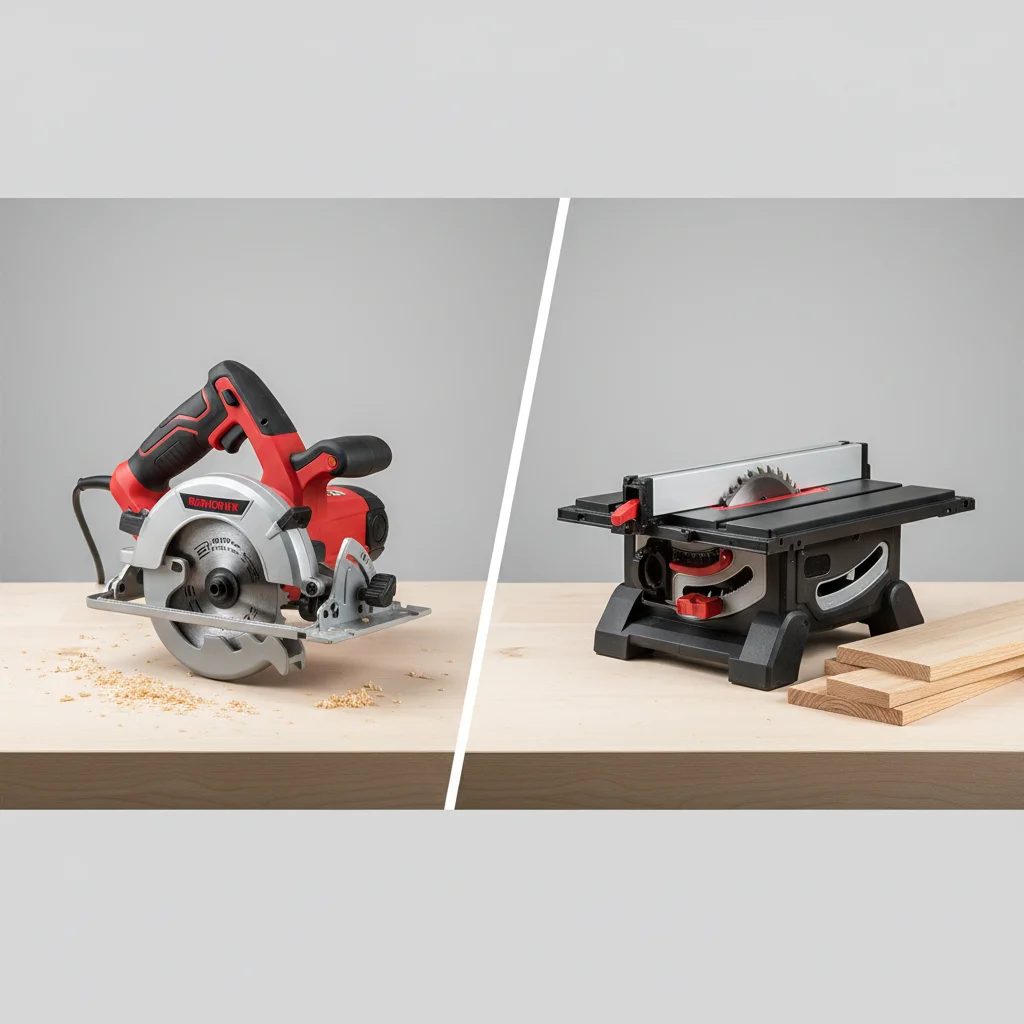
Deciding between a circular saw and a table saw is a common dilemma for many woodworkers and DIY enthusiasts. While both tools are designed for cutting wood, they excel in different applications and offer distinct advantages. The right choice depends on your primary projects, available space, and budget. For portability and versatility in rough cuts, a circular saw is often the better choice, whereas for precision, repetitive cuts, and sheet goods, a table saw offers superior stability and accuracy.
Understanding the Circular Saw’s Strengths
A circular saw is a handheld power tool that uses a toothed blade to cut materials. Its primary advantage lies in its portability and ability to make cuts in various locations, including on large workpieces that cannot be easily moved. Circular saws are excellent for cross-cutting lumber, ripping boards, and making plunge cuts. They are also highly versatile, capable of cutting different materials like wood, metal, and masonry with the appropriate blade. This makes them indispensable for framing, deck building, and general construction tasks.
However, achieving perfectly straight and consistent cuts with a circular saw often requires practice and the use of guides or clamps. While some models offer advanced features like laser guides, the inherent nature of a handheld tool means there’s a greater margin for error compared to a stationary machine. They are also less ideal for very small pieces or intricate joinery.
The Table Saw’s Precision and Power
A table saw is a stationary power tool with a circular saw blade mounted under a table. The material is fed into the blade across the table, providing a stable and controlled cutting environment. Table saws are renowned for their precision, making them the go-to tool for ripping long boards, cutting sheet goods like plywood and MDF, and creating accurate dados and rabbets. Their fence system ensures consistent, repeatable cuts, which is crucial for furniture making, cabinet building, and other fine woodworking projects.
The main drawbacks of a table saw include its size, lack of portability, and higher cost. They require a dedicated space in a workshop and are not suitable for on-site work where mobility is key. Safety is also a significant consideration, as table saws can be dangerous if not operated correctly. However, for anyone serious about woodworking and needing consistent, high-quality cuts, a table saw is an invaluable investment.
Key Differences in Application and Performance
|
Our Picks for the Best Circular Saw in 2026
As an Amazon Associate I earn from qualifying purchases.
|
||
| Num | Product | Action |
|---|---|---|
| 1 | Makita 5377MG 7-1/4" Magnesium Hypoid Saw |

|
| 2 | Ryobi 14 Amp 7-1/4" Adjustable Electric Circular Saw w/Exactline Laser | CSB135L |
|
| 3 | Cordless Circular Saw 6-1/2" for Makita 18V Battery (Not Inclued), 4500RPM Power Circular Saws w/Laser Guide, 0-45° Bevel Capability, Max 2-3/16" Depth, Electric Saw for Wood Plastic |
|
| 4 | Seesii Mini Circular Saw with Laser Guide,4.8A 4000 RPM Compact Corded Circular Saw with Rip Guide,3 Blades (4-1/2") for Wood,Soft Metal,Tile,Plastic Cutting,Max Cut Depth 1-11/16"(90°),1-1/8" (45°) |
|
| 5 | Mini Circular Saw, 4Amp 3500RPM Corded Compact Saw with 4-1/2" 24T TCT Blades, Laser Guide, Rip Guide, Vacuum Adapter and Blade Wrench, Max Cutting Depth 1-11/16"(90°), 1-1/8"(45°) |
|
| 6 | Ridgid ZRR32104 THRUCOOL 7-1/4 in. Worm Drive Saw (Renewed) |
|
| 7 | RYOBI Circular Saw CSB125 13-Amp 7-1/4 in. Electric (Renewed) |
|
| 8 | RIDGID 18V Cordless 6 1/2 in. Circular Saw (Tool Only) |
|
| 9 | Makita 5477NB 7-1/4" Hypoid Saw |
|
| 10 | RIDGID 18V SUBCOMPACT BRUSHLESS Cordless 6-1/2 in. Circular Saw Tool ONLY R8656B |
|
The fundamental difference between these two saws lies in their application. A circular saw is a mobile workhorse, ideal for breaking down large materials, making quick cuts, and working in various environments. It’s the tool you grab for rough framing or when you need to cut a piece of plywood that’s too large to lift onto a table.
A table saw, conversely, is a stationary precision instrument. It excels at tasks requiring exact dimensions and repeatable results, such as cutting multiple pieces to the same width or creating intricate joinery. If your projects involve a lot of ripping, cross-cutting smaller pieces, or working with sheet goods, a table saw will significantly improve your efficiency and accuracy.
When to Choose Which Saw
Consider your typical projects and workspace. If you primarily work on construction projects, outdoor builds, or need to cut large materials on-site, a circular saw is likely your best bet. Its versatility and portability make it an essential tool for many DIYers and professionals. If your work involves fine woodworking, furniture building, or projects that demand extreme precision and repeatable cuts, a table saw will be a more suitable and ultimately more satisfying investment. Many serious woodworkers eventually own both, using the circular saw for initial breakdown and the table saw for refinement.
- Circular Saw Advantages: Portability, lower cost, ideal for large workpieces, versatile for various materials.
- Table Saw Advantages: High precision, repeatable cuts, excellent for ripping and sheet goods, safer for small pieces.
- Circular Saw Disadvantages: Less precise for long rips, requires practice for straight cuts, can be tiring for repetitive tasks.
- Table Saw Disadvantages: Stationary, higher cost, requires dedicated space, can be intimidating for beginners.
- Best for Both: Many professionals and serious hobbyists find value in owning both tools to cover a wider range of tasks efficiently.
Making Your Decision
Ultimately, the choice between a circular saw and a table saw boils down to your specific needs. If you’re just starting out or have limited space and budget, a good quality circular saw with a reliable guide can handle a surprising amount of work. As your skills and projects evolve, you might find yourself needing the precision and efficiency that only a table saw can offer. Consider renting each type of saw for a project or two to get a feel for their capabilities before making a significant purchase.
