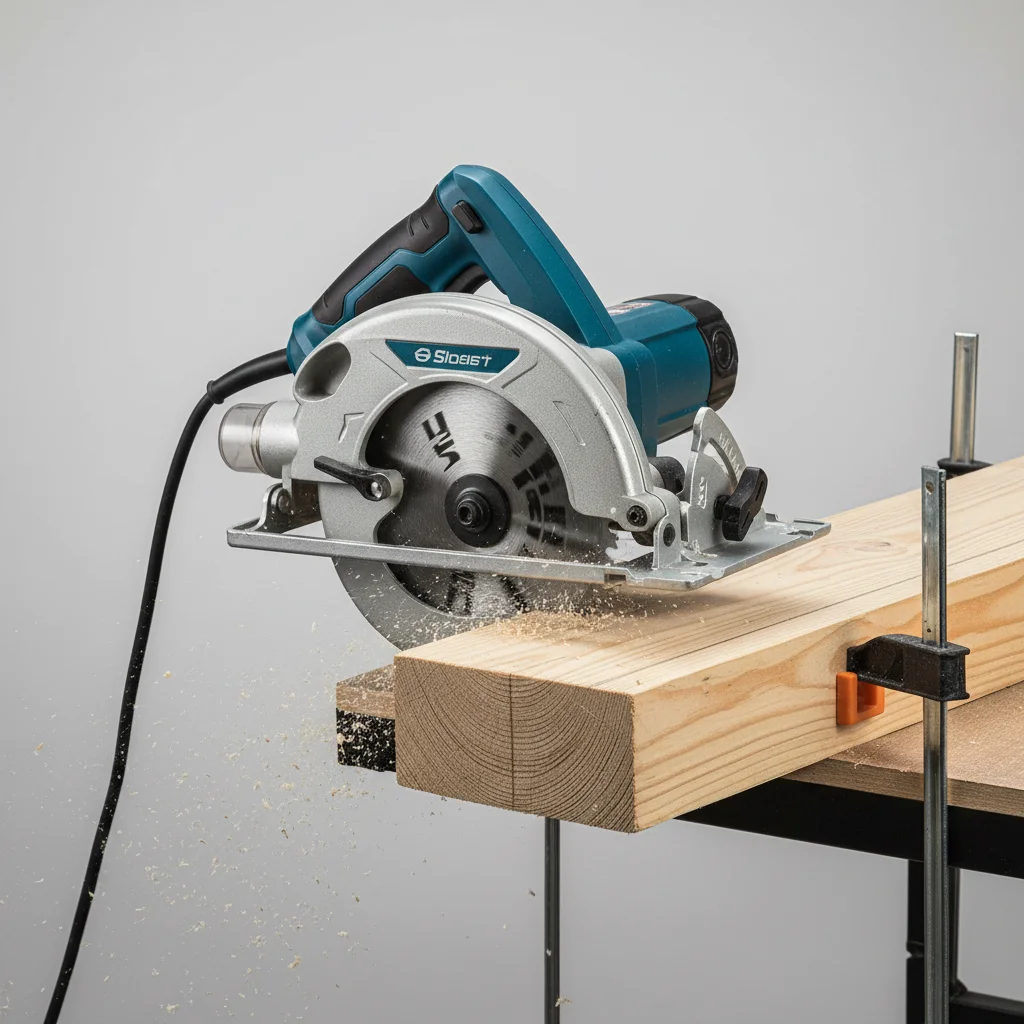
Mastering circular saw bevel cuts is essential for achieving precise angles in your woodworking projects. This guide will walk you through the process, ensuring you can confidently make accurate angled cuts every time. We’ll cover everything from setting up your saw to making the cut and troubleshooting common issues.
Understanding Bevel Angles and Your Circular Saw
A bevel cut is an angled cut made through the thickness of a board, as opposed to a miter cut which is an angled cut made across the width. Most circular saws allow for bevel adjustments, typically up to 45 or 50 degrees. Locate the bevel adjustment lever or knob on your saw, usually near the front of the base plate. This mechanism allows you to tilt the blade relative to the shoe, creating the desired angle for your cut.
Before making any cuts, always ensure your saw is unplugged when making adjustments. Familiarize yourself with the angle markings on your saw’s base plate. For critical projects, it’s advisable to use a digital angle gauge to verify the exact angle, as the saw’s built-in scale can sometimes be slightly off. This extra step ensures maximum accuracy for your project.
Setting Up for Accurate Bevel Cuts
Proper setup is crucial for accurate bevel cuts. First, secure your workpiece firmly to prevent any movement during the cut. Clamps are your best friend here. Next, mark your cut line clearly on the material. When making a bevel cut, remember that the blade will enter the material at an angle, so the kerf (the width of the cut) will be wider on one side. Account for this when positioning your saw.
Adjust your saw’s depth of cut so that the blade extends just slightly below the material. This minimizes kickback and provides a cleaner cut. For optimal results, consider using a blade specifically designed for fine crosscuts or plywood, as these often have more teeth and produce smoother edges, especially important for angled cuts where tear-out can be more pronounced.
- Always wear safety glasses and hearing protection.
- Ensure the workpiece is stable and clamped securely.
- Verify the bevel angle with an external gauge for critical cuts.
- Set the blade depth just past the material thickness.
- Use a sharp, appropriate blade for the material.
Making the Bevel Cut
|
Our Picks for the Best Circular Saw in 2026
As an Amazon Associate I earn from qualifying purchases.
|
||
| Num | Product | Action |
|---|---|---|
| 1 | RIDGID 18V Cordless 6 1/2 in. Circular Saw (Tool Only) |

|
| 2 | Makita 5477NB 7-1/4" Hypoid Saw |
|
| 3 | Mini Circular Saw, 4Amp 3500RPM Corded Compact Saw with 4-1/2" 24T TCT Blades, Laser Guide, Rip Guide, Vacuum Adapter and Blade Wrench, Max Cutting Depth 1-11/16"(90°), 1-1/8"(45°) |
|
| 4 | Cordless Circular Saw 6-1/2" for Makita 18V Battery (Not Inclued), 4500RPM Power Circular Saws w/Laser Guide, 0-45° Bevel Capability, Max 2-3/16" Depth, Electric Saw for Wood Plastic |
|
| 5 | RYOBI Circular Saw CSB125 13-Amp 7-1/4 in. Electric (Renewed) |
|
| 6 | RIDGID 18V SUBCOMPACT BRUSHLESS Cordless 6-1/2 in. Circular Saw Tool ONLY R8656B |
|
| 7 | Makita 5377MG 7-1/4" Magnesium Hypoid Saw |
|
| 8 | Ridgid ZRR32104 THRUCOOL 7-1/4 in. Worm Drive Saw (Renewed) |
|
| 9 | Ryobi 14 Amp 7-1/4" Adjustable Electric Circular Saw w/Exactline Laser | CSB135L |
|
| 10 | Seesii Mini Circular Saw with Laser Guide,4.8A 4000 RPM Compact Corded Circular Saw with Rip Guide,3 Blades (4-1/2") for Wood,Soft Metal,Tile,Plastic Cutting,Max Cut Depth 1-11/16"(90°),1-1/8" (45°) |
|
With your saw set up and your workpiece secured, it’s time to make the cut. Start the saw before the blade touches the material and allow it to reach full speed. Guide the saw smoothly and consistently along your marked line. Avoid forcing the saw, as this can lead to an uneven cut, blade binding, or even kickback. Maintain a firm grip on the saw with both hands.
For longer bevel cuts, especially on wider boards, consider using a straight edge or a guide rail. This will help maintain a consistent angle and straight line throughout the entire cut, which is particularly challenging with freehand bevel cuts. Take your time and let the saw do the work.
Common Challenges and Troubleshooting
One common issue with bevel cuts is tear-out, especially on the top surface of the material. To minimize this, you can score the cut line with a utility knife before making the saw cut, or place painter’s tape along the cut line. Another effective method is to use a sacrificial board underneath your workpiece; this provides support for the wood fibers as the blade exits, reducing splintering.
If your bevel cuts are not consistently accurate, recheck your saw’s calibration. The bevel scale can sometimes be knocked out of alignment. You can recalibrate it by loosening the adjustment screws, setting the blade to a perfect 90 degrees using a reliable square, and then tightening the screws. If you’re struggling with maintaining a straight line, practice on scrap material or invest in a high-quality saw guide.
Finishing Your Angled Projects
Once you’ve mastered the art of circular saw bevel cuts, a whole new world of woodworking projects opens up. From creating custom picture frames and intricate trim work to building sturdy furniture with angled joinery, precise bevels are a fundamental skill. Remember that practice makes perfect, so don’t be afraid to experiment with different angles and materials. Always prioritize safety, and your projects will benefit from the clean, accurate angles you achieve.

I was trying to build some planter boxes with angled sides and kept messing up the cuts. This explanation of how to tilt the blade relative to the shoe made so much sense. My cuts are finally accurate, and the boxes look professional. Thanks for making it so easy to understand!
The advice on unplugging the saw before making adjustments is crucial, and I appreciate that it was highlighted. However, I found the section on locating the bevel adjustment lever a bit basic. For someone with a bit more experience, it felt like it could have delved deeper into specific saw models or more advanced techniques. Still, a solid refresher.
I’ve always struggled with getting my bevel cuts just right, especially for those tricky 45-degree angles. This guide really broke down the process of setting up the saw and making the cut. My last project, a custom bookshelf, turned out so much cleaner thanks to these tips. Definitely a game-changer for my woodworking.
Good info here, especially the part about understanding the difference between bevel and miter cuts. I used to get those mixed up all the time. My Ryobi saw only goes to 45 degrees, but the instructions for adjusting the lever were spot on. Would have liked a bit more on troubleshooting common issues, but overall very helpful.