Choosing the right circular saw can dramatically impact your woodworking and construction projects, transforming difficult cuts into precise, effortless tasks. For many, especially those who prioritize an unobstructed view of their cutting line, the traditional right-bladed saw can feel counter-intuitive. This is where left-handed, or “blade-left,” circular saws come into their own, offering a design that significantly enhances visibility and control. If you’ve ever found yourself craning your neck or struggling to see your mark, a blade-left saw could be the game-changer you need. This guide will delve into the world of left-handed circular saws, exploring their unique advantages, the top models for 2026, and everything you need to know to make an informed choice for your workshop.
Overview of Left-Handed Circular Saws
A left-handed circular saw is primarily defined by the placement of its blade on the left side of the motor housing. This configuration is often a standard feature in many worm-drive saws and has become increasingly popular in smaller, more compact sidewinder models, particularly those with 6.5-inch blades. The design offers distinct operational benefits that set it apart from its right-bladed counterparts.
Historically, circular saws evolved with various motor placements, leading to the two main types: sidewinders and worm drives. Sidewinders typically have the motor mounted directly beside the blade, making them lighter and more compact. Worm-drive saws, on the other hand, feature a motor positioned behind the blade, connected via a worm gear, which delivers higher torque but often results in a longer, heavier tool. Traditionally, worm drives were almost exclusively blade-left, while sidewinders were blade-right. However, modern manufacturing has blurred these lines, offering blade-left options across both categories, responding to user demand for better cut line visibility.
The primary advantage of a blade-left design is superior cut line visibility. For a right-handed operator, the blade-left configuration keeps the blade on the visible side of the cut line, allowing for a clear, unobstructed view as the saw moves through the material. This eliminates the need to lean over the saw or adjust your stance awkwardly, making cuts more intuitive and accurate. For left-handed users, this design provides a natural and comfortable cutting experience, aligning with their dominant hand’s perspective. Beyond visibility, these saws often offer improved balance. With the motor’s weight positioned over the main workpiece rather than the offcut, the saw feels more stable during operation, reducing the likelihood of binding or kickback and making it easier to manage when trimming narrower pieces or cutting sheet goods.
One notable disadvantage, particularly for right-handed users, can be the direction of sawdust ejection. With the blade on the left, sawdust often blows towards the operator during rip cuts. However, many modern saws mitigate this with efficient dust ports and improved dust collection systems, and attachments can further reduce this issue. While some traditionalists might raise safety concerns regarding kickback direction, modern saws with advanced safety features like electric blade brakes and robust blade guards effectively address these worries, making blade-left saws a safe and highly functional choice for a wide range of tasks.
 A left-handed circular saw in action, showing the clear line of sight to the blade as it cuts through a piece of wood.
Why Choose a Left-Handed Circular Saw?
The decision to opt for a left-handed circular saw often stems from a desire for enhanced precision, comfort, and control during cutting tasks. The most compelling reason is the vastly improved cut line visibility. When using a standard right-bladed saw, right-handed operators often find their view of the blade and the cutting line obscured by the motor housing or their own arm. A blade-left saw remedies this by positioning the blade on the operator’s side, allowing for a direct and clear line of sight down the cut. This means less guessing and more confidence, especially when making critical cuts that demand high accuracy.
Moreover, the ergonomic benefits extend beyond mere visibility. Many users report that blade-left saws feel more balanced and natural to operate. The weight distribution, with the motor often situated over the supported part of the material, can lead to greater stability throughout the cut. This is particularly advantageous when breaking down large sheets of plywood or making long rip cuts, where maintaining a steady hand is crucial. This improved balance minimizes wobble and helps in preventing the saw from tipping, especially when the offcut piece is small.
For left-handed individuals, choosing a blade-left saw is a logical step towards a more natural and comfortable workflow. While many left-handers have adapted to using right-bladed tools, a saw designed with their dominant hand in mind can significantly reduce fatigue and improve overall efficiency. The natural hand placement and sight line alignment make for a more intuitive experience, transforming potentially awkward operations into smooth, controlled movements.
> “The moment you experience the clear sight line of a blade-left circular saw, it’s hard to go back. It’s not just for left-handers; it’s about seeing your work with confidence.” – John Miller, Master Carpenter
While some might express concerns about safety, particularly regarding kickback and sawdust, modern engineering has largely addressed these issues. Electric blade brakes stop the blade almost instantly when the trigger is released, and well-designed blade guards offer comprehensive protection. Many models also incorporate effective dust management systems that either direct sawdust away from the operator or allow for connection to a vacuum, mitigating the dust spray often associated with blade-left designs. Ultimately, a left-handed circular saw offers a more streamlined, precise, and comfortable cutting experience for a broad spectrum of users.
Key Factors When Selecting a Left-Handed Circular Saw
Choosing the ideal left-handed circular saw involves considering several critical factors to ensure it meets your specific project needs and preferences. Each element plays a vital role in the saw’s performance, comfort, and suitability for different applications.
First, consider the Power Source: Corded saws offer continuous, unwavering power, making them ideal for heavy-duty, prolonged tasks without worrying about battery life. They are often found in larger blade sizes and can provide higher RPMs. Cordless saws, conversely, prioritize portability and convenience. Powered by rechargeable batteries (typically 18V or 20V platforms), they allow for freedom of movement without being tethered to an outlet. When opting for cordless, factors like battery voltage, amp-hour (Ah) capacity (which dictates runtime), and compatibility with existing tool systems are crucial.
Next, the Motor Type significantly impacts performance and handling. Sidewinder saws, with their motor mounted alongside the blade, are generally lighter and more compact, offering higher blade speeds (RPM). They are well-suited for quick, lighter cuts and overhead work. Worm-drive saws, with their motor positioned at the rear and connected via gears, deliver superior torque, making them excellent for cutting through dense or wet materials. They are typically longer and heavier, offering a different balance. Hypoid saws are a variation of worm drives, featuring a sealed motor system that requires less maintenance and often boosts efficiency. For blade-left designs, worm drives have traditionally been the standard, though sidewinder blade-left options are increasingly common.
Blade Size and Cutting Capacity are paramount. Common blade sizes for circular saws include 6.5-inch and 7.25-inch. A 6.5-inch blade is often found on more compact, lighter saws, frequently with blade-left configurations, and is excellent for common cross and rip cuts through dimensional lumber and sheet goods. A 7.25-inch blade provides a deeper cutting capacity, allowing it to cut through thicker materials or make single-pass cuts through two-by lumber at an angle, and blades are more readily available.
Ergonomics and Handle Design heavily influence user comfort and control. Look for features like rubber-coated grips that reduce vibration and improve handling, especially during extended use. The balance of the saw in your hands is also important, as a well-balanced tool reduces fatigue.
Safety Features are non-negotiable. An electric blade brake is highly recommended as it stops the blade quickly upon trigger release, minimizing coasting time and reducing accident risk. Robust blade guards that retract smoothly are essential. Additional safety elements like guarded triggers prevent accidental startups.
Finally, consider Additional Features and your Budget. Features like laser guides or LED work lights can improve cut accuracy and visibility in dimly lit environments. Dust collection ports are invaluable for keeping your workspace clean and your cut line clear, with some offering directional control. A rafter hook adds convenience for hanging the saw when not in use. Your budget will naturally narrow down options, but remember that investing in a quality tool often pays off in durability, performance, and safety.
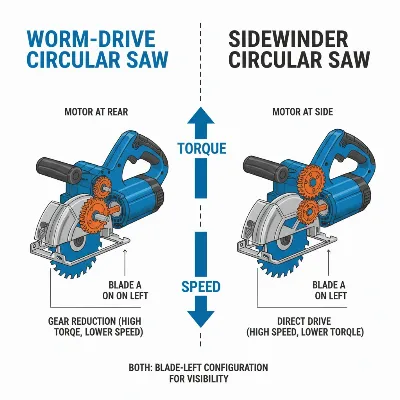 Comparison between worm-drive and sidewinder circular saws, highlighting motor placement and blade orientation.
Top 5 Best Left-Handed Circular Saws for 2026
When it comes to selecting a top-tier left-handed circular saw, several models stand out in 2026 for their performance, design, and user-focused features. These saws offer the coveted blade-left configuration, ensuring excellent cut line visibility and superior control.
1. SKILSAW SPT77WML-01 15-Amp Lightweight Worm Drive Circular Saw
|
Our Picks for the Best Circular Saw in 2026
As an Amazon Associate I earn from qualifying purchases.
|
||
| Num | Product | Action |
|---|---|---|
| 1 | Ryobi 14 Amp 7-1/4" Adjustable Electric Circular Saw w/Exactline Laser | CSB135L |

|
| 2 | Makita 5477NB 7-1/4" Hypoid Saw |
|
| 3 | Makita 5377MG 7-1/4" Magnesium Hypoid Saw |
|
| 4 | Mini Circular Saw, 4Amp 3500RPM Corded Compact Saw with 4-1/2" 24T TCT Blades, Laser Guide, Rip Guide, Vacuum Adapter and Blade Wrench, Max Cutting Depth 1-11/16"(90°), 1-1/8"(45°) |
|
| 5 | RIDGID 18V SUBCOMPACT BRUSHLESS Cordless 6-1/2 in. Circular Saw Tool ONLY R8656B |
|
| 6 | Ridgid ZRR32104 THRUCOOL 7-1/4 in. Worm Drive Saw (Renewed) |
|
| 7 | Cordless Circular Saw 6-1/2" for Makita 18V Battery (Not Inclued), 4500RPM Power Circular Saws w/Laser Guide, 0-45° Bevel Capability, Max 2-3/16" Depth, Electric Saw for Wood Plastic |
|
| 8 | RIDGID 18V Cordless 6 1/2 in. Circular Saw (Tool Only) |
|
| 9 | RYOBI Circular Saw CSB125 13-Amp 7-1/4 in. Electric (Renewed) |
|
| 10 | Seesii Mini Circular Saw with Laser Guide,4.8A 4000 RPM Compact Corded Circular Saw with Rip Guide,3 Blades (4-1/2") for Wood,Soft Metal,Tile,Plastic Cutting,Max Cut Depth 1-11/16"(90°),1-1/8" (45°) |
|
The SKILSAW SPT77WML-01 consistently ranks as a top choice for professionals and serious DIYers seeking a blade-left option. This 15-amp worm drive saw is renowned for its exceptional power and durability, thanks to its lightweight magnesium construction. It’s often cited as one of the lightest worm drive saws on the market, making it more maneuverable despite its robust performance. The “Dual-Field” motor is specifically designed for circular saw applications, delivering optimal power and efficiency, especially when tackling tough, wet, or dense materials. Its blade-left design offers unparalleled visibility for right-handed users looking directly down the cutting line.
2. DEWALT 20V MAX Circular Saw, Cordless, 6-1/2-Inch (DCS391B)
For those prioritizing cordless convenience without sacrificing a blade-left orientation, the DEWALT DCS391B is an outstanding contender. This 20V MAX cordless saw, featuring a 6.5-inch blade, strikes an excellent balance between power, portability, and user comfort. Its blade-left design, combined with a comfortable, ergonomic grip, provides great control and visibility. While it may not match the raw power of a corded worm drive for continuous heavy-duty work, it’s highly capable for most framing, carpentry, and DIY tasks, easily cutting through 2x material at 45 degrees in a single pass. Its integration into the DEWALT 20V MAX battery system makes it a popular choice for users already invested in the platform.
3. Bosch CCS180B 18V EC Brushless 6-1/2 In. Circular Saw
The Bosch CCS180B offers a compelling blend of ergonomic design, advanced motor technology, and reliable performance in a blade-left configuration. This 18V EC Brushless saw boasts a 6.5-inch blade and is praised for its well-built structure and responsive safety features, including a quick-stopping blade brake. The ergonomic rubber-coated handle ensures comfortable operation, even during extended use. The brushless motor contributes to longer tool life, increased efficiency, and extended run time. Its blade-left design provides clear sight to the cutting line, and the overall balance of the tool makes it a strong contender for precision work and general construction.
4. Makita XSH03Z 18V LXT Lithium-Ion Brushless Cordless 6-1/2″ Circular Saw
Makita’s XSH03Z is a compact and lightweight cordless circular saw featuring an 18V LXT Lithium-Ion battery system. This 6.5-inch blade-left model is known for its smooth cutting performance and impressive runtime, thanks to its efficient brushless motor. Designed with ergonomics in mind, it prioritizes user comfort and maneuverability, making it ideal for precision trim work and general remodeling tasks. The saw’s lightweight nature reduces fatigue, and its balanced design, with the blade on the left, offers excellent visibility for accurate cuts. It’s a fantastic option for professionals and enthusiasts who value a lightweight, agile, and powerful cordless tool.
5. SKILSAW SPT67M8-01 15 Amp Magnesium Left Blade Sidewinder Circular Saw
For those who prefer the speed and lighter feel of a sidewinder but demand the visibility of a blade-left design, the SKILSAW SPT67M8-01 delivers. This 15-amp magnesium sidewinder stands out by combining powerful performance with a lightweight, durable magnesium foot plate and housing. Its blade-left orientation ensures an unobstructed view of the cutting line, which is a significant advantage for precise work. The saw is engineered for speed and clean cuts, making it suitable for a wide range of materials from plywood to dimensional lumber. It bridges the gap between traditional sidewinder benefits and the visual advantages of a left-bladed saw.
How to Safely and Effectively Use Your Left-Handed Circular Saw
Operating any power tool requires adherence to safety protocols, and a left-handed circular saw is no exception. Proper usage not only ensures your safety but also maximizes the tool’s effectiveness and the quality of your cuts.
Before starting any cut, perform pre-operation checks. Always ensure the blade is sharp, clean, and securely fastened, and that the blade guard moves freely and retracts properly. Inspect the power cord (for corded saws) or battery (for cordless saws) for any damage. Wear appropriate personal protective equipment (PPE), including safety glasses, hearing protection, and dust mask. Avoid loose clothing or jewelry that could get caught in moving parts.
For proper cutting techniques, a stable stance is crucial. Position your body to the side of the saw, rather than directly behind it, to maintain better control and keep clear of potential kickback zones. Ensure your workpiece is firmly clamped or adequately supported to prevent movement during the cut. When initiating a cut, allow the saw to reach full speed before engaging the material. Guide the saw smoothly along your marked line, applying consistent, moderate pressure. Let the saw do the work; forcing it can lead to binding, kickback, and a poor-quality cut. For blade-left saws, utilize the excellent cut line visibility by keeping your eyes on the blade’s entry point and the marked line.
Dust management is an important aspect of both safety and cut quality. Many left-handed saws feature effective dust ports that can be connected to a shop vacuum to minimize airborne dust and keep your cut line clear. If a vacuum isn’t an option, a dust mask is essential.
Changing the blade safely involves a few steps. First, always disconnect the saw from its power source (unplug corded saws or remove the battery from cordless ones). Consult your saw’s manual for specific instructions, but generally, you’ll engage the blade lock button and use the provided blade wrench to loosen the arbor nut, removing the old blade. Ensure the new blade is installed with the teeth pointing in the correct direction for rotation (usually indicated by an arrow on the blade and saw). Tighten the arbor nut securely, but avoid overtightening.
Finally, maintenance tips will extend the life of your saw. Regularly clean your saw, especially around the blade and motor vents, to prevent sawdust buildup, which can cause overheating and reduced performance. Check the blade and motor brushes (if applicable) periodically for wear. Store your saw in a clean, dry place, ideally in its case, to protect it from dust and damage.
 A person safely operating a left-handed circular saw, showcasing proper hand placement, safety glasses, and clear visibility of the cut line on a wooden board.
Applications and Projects for Left-Handed Circular Saws
Left-handed circular saws are versatile tools that excel in a myriad of applications, from robust construction and intricate carpentry to everyday DIY projects. Their distinct blade-left configuration offers advantages that make them particularly suitable for certain tasks.
In framing and general carpentry, these saws are highly valued for their ability to provide clear sight lines when cutting dimensional lumber. Whether you’re cross-cutting studs, ripping plywood for sheathing, or making precise cuts for roof trusses, the unobstructed view helps carpenters maintain accuracy and efficiency. This is especially beneficial when working in dynamic construction environments where quick, accurate cuts are essential.
For breaking down sheet goods, such as plywood, MDF, or OSB, a left-handed circular saw proves to be incredibly effective. When cutting large panels, operators often guide the saw with their dominant hand, and having the blade on the left means you can keep a direct line of sight on your cutting mark without leaning excessively. This allows for straighter, more controlled cuts across long distances, reducing material waste and improving overall project quality. This also shines when cutting out openings for windows or doors in sheet materials, as the saw’s weight often rests on the larger, more stable part of the material.
DIY (Do-It-Yourself) projects greatly benefit from the enhanced control and visibility offered by blade-left saws. Whether you’re building shelves, constructing garden furniture, or undertaking home renovation tasks, the ease of seeing your cut line translates to more professional-looking results. Projects that involve precise joinery, dadoes (with appropriate blade changes and jigs), or intricate cuts become less daunting.
For specialty cuts, such as those requiring bevels or miters, the left-blade design can sometimes offer unique advantages depending on the material and angle. Some users find it easier to monitor the blade’s interaction with the material at various angles due to the clearer sightline. The adaptability of these saws, especially when paired with guides or track systems, further expands their utility for custom woodworking. Ultimately, the inherent design benefits of left-handed circular saws make them a preferred choice for anyone prioritizing precision, comfort, and a clear view of their work across a broad spectrum of cutting applications.
Conclusion
Choosing the right circular saw can truly elevate your craftsmanship, and for many, the left-handed circular saw offers an unparalleled advantage in visibility and control. By positioning the blade on the left, these saws provide an unobstructed view of your cutting line, making every cut more accurate and intuitive. Whether you’re a seasoned professional tackling complex framing jobs or a DIY enthusiast embarking on a new project, the enhanced precision and ergonomic comfort of a blade-left saw can significantly improve your workflow and the quality of your results.
From the high-torque power of a SKILSAW worm drive to the portable efficiency of a DEWALT cordless model, the market in 2026 offers exceptional left-handed options designed to meet diverse needs. Prioritizing features like power source, motor type, safety, and ergonomics will guide you to the perfect tool. Investing in a quality left-handed circular saw means investing in cleaner cuts, greater confidence, and a more enjoyable woodworking experience. So, are you ready to see your cuts with newfound clarity?
Frequently Asked Questions
Are left-handed circular saws only for left-handed people?
No, left-handed circular saws are highly beneficial for right-handed users too. The main advantage is the improved line of sight to the blade and cutting line, which is often obstructed by the motor housing on traditional right-bladed saws when operated by a right-handed person.
What’s the main difference between worm drive and sidewinder left-handed saws?
Worm-drive saws typically have their motor at the rear, connected via gears, offering higher torque for tougher materials, and are often heavier. Sidewinder saws have their motor mounted directly on the side of the blade, making them lighter, more compact, and capable of higher RPMs. Both can feature blade-left designs.
Can I use a left-handed saw with a track guide?
Yes, many left-handed circular saws can be used effectively with track guides or straight edges. The clear line of sight often makes it easier to align the saw precisely with the guide, contributing to accurate, straight cuts.
How often should I change the blade?
The frequency of blade changes depends on usage, material being cut, and blade quality. A dull blade will cut slowly, cause burn marks, and increase the risk of kickback. Change your blade when you notice reduced cutting efficiency, excessive splintering, or if teeth are damaged.
Are cordless left-handed saws as powerful as corded ones?
While corded saws generally offer continuous, often higher, power, modern cordless left-handed saws (especially those with brushless motors and high-voltage batteries) are very powerful and capable for most tasks. They provide excellent portability and are increasingly closing the power gap with their corded counterparts.
