Achieving flawless, splinter-free cuts on large sheets of plywood can be a daunting task for even seasoned woodworkers. Traditional circular saws often fall short, leaving rough edges and demanding additional cleanup. This is where the precision of a track saw becomes indispensable, transforming cumbersome sheet good breakdown into a straightforward, accurate process. As an experienced technician with a decade of expertise in various saws, particularly band saws, I understand the critical difference the right tool makes. This article will guide you through the world of track saws, highlighting their unique advantages, key features, and ultimately presenting the top 5 models best suited for cutting plywood in 2026, ensuring you find the perfect partner for your projects.
Overview of Track Saws
A track saw, often referred to as a plunge saw, is essentially a specialized circular saw designed to run along an extruded guide rail. This ingenious system allows for incredibly straight, precise cuts, a feat often challenging to achieve with a freehand circular saw or even a table saw when handling oversized materials. While circular saws have existed for ages, the modern plunge-cut track saw gained prominence by offering unparalleled accuracy and control, especially for delicate sheet goods like plywood and MDF.
Compared to standard circular saws, track saws boast several significant advantages, particularly for plywood. They virtually eliminate tear-out thanks to a splinter guard or zero-clearance edge on the track, resulting in factory-like edges directly off the saw. Superior dust collection, often achieved through integrated dust ports and compatible vacuum systems, keeps your workspace cleaner and improves visibility. Safety is also greatly enhanced with an enclosed blade that only exposes during the plunge cut, along with features like riving knives and anti-kickback mechanisms. However, this precision and added functionality come with a higher price tag and slightly less inherent portability than a bare circular saw, as the track itself adds bulk.
Key Features of a Great Track Saw for Plywood
When selecting a track saw, especially for demanding tasks like cutting plywood, certain features stand out as critical for performance, safety, and overall user experience. Understanding these will help you make an informed decision.
Power is paramount. For corded models, look for a motor with at least 12 amps to ensure it can cut through various thicknesses and densities of plywood without bogging down. Cordless track saws have made significant strides, with powerful brushless motors now rivaling corded performance, offering excellent portability for job sites or workshops without readily available outlets. Blade diameter typically ranges from 6.5 to 7.25 inches, with higher quality carbide-tipped blades delivering cleaner cuts.
Variable speed control is another crucial feature, allowing you to adjust the blade RPM to suit different materials, minimizing tear-out on delicate veneers and maximizing efficiency on thicker stock. A wide bevel capacity, often ranging from -1 to 47 degrees, offers versatility for angled cuts required in cabinetry or furniture. Precise depth of cut adjustment is essential, enabling you to score material on a shallow first pass to prevent splintering before making a full-depth cut.
The track system itself is the heart of the tool. Look for rails with a stable, anti-slip bottom that securely grips the workpiece, ideally without needing clamps for every cut, especially for longer rips. The ease of setup and alignment of the track, including the ability to connect multiple rails seamlessly for extra-long cuts, directly impacts your workflow efficiency. Excellent dust collection performance is non-negotiable when working with plywood, which generates a fine, pervasive dust. An integrated dust port that connects effectively to a vacuum will keep your air cleaner and your cut line visible. Finally, advanced safety features such as a fully enclosed blade, a riving knife to prevent kickback, and kickback stops on the track are vital for safe operation.
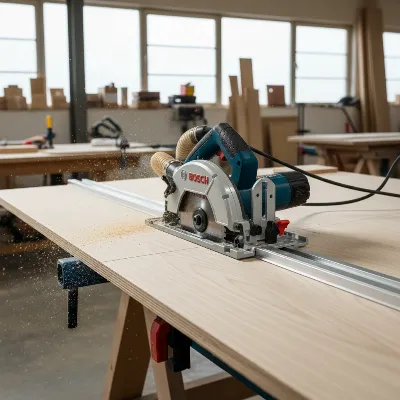 A track saw cutting a large sheet of plywood with precision, showing the saw on the guide rail and minimal sawdust.
Top 5 Best Track Saws for Cutting Plywood in 2026
The market for track saws continues to evolve, with manufacturers pushing the boundaries of precision and portability. Based on extensive testing and user feedback, here are the top 5 track saws that excel at cutting plywood in 2026.
1. Bosch GKT13-225 / GKT13-255L Professional Track Saw: Best Overall
|
Our Picks for the Best Circular Saw in 2026
As an Amazon Associate I earn from qualifying purchases.
|
||
| Num | Product | Action |
|---|---|---|
| 1 | Makita 5477NB 7-1/4" Hypoid Saw |

|
| 2 | Cordless Circular Saw 6-1/2" for Makita 18V Battery (Not Inclued), 4500RPM Power Circular Saws w/Laser Guide, 0-45° Bevel Capability, Max 2-3/16" Depth, Electric Saw for Wood Plastic |
|
| 3 | Ryobi 14 Amp 7-1/4" Adjustable Electric Circular Saw w/Exactline Laser | CSB135L |
|
| 4 | RIDGID 18V SUBCOMPACT BRUSHLESS Cordless 6-1/2 in. Circular Saw Tool ONLY R8656B |
|
| 5 | Seesii Mini Circular Saw with Laser Guide,4.8A 4000 RPM Compact Corded Circular Saw with Rip Guide,3 Blades (4-1/2") for Wood,Soft Metal,Tile,Plastic Cutting,Max Cut Depth 1-11/16"(90°),1-1/8" (45°) |
|
| 6 | Ridgid ZRR32104 THRUCOOL 7-1/4 in. Worm Drive Saw (Renewed) |
|
| 7 | RYOBI Circular Saw CSB125 13-Amp 7-1/4 in. Electric (Renewed) |
|
| 8 | RIDGID 18V Cordless 6 1/2 in. Circular Saw (Tool Only) |
|
| 9 | Makita 5377MG 7-1/4" Magnesium Hypoid Saw |
|
| 10 | Mini Circular Saw, 4Amp 3500RPM Corded Compact Saw with 4-1/2" 24T TCT Blades, Laser Guide, Rip Guide, Vacuum Adapter and Blade Wrench, Max Cutting Depth 1-11/16"(90°), 1-1/8"(45°) |
|
The Bosch GKT13-225 (or the GKT13-255L, depending on the kit) stands out as the best overall choice for its exceptional blend of power, precision, and user-friendly features. Equipped with a robust 13-amp motor and a 6.5-inch blade, this plunge saw delivers remarkably precise, splinter-free cuts in plywood, hardwoods, and other sheet goods. Its track guidance system ensures unparalleled accuracy, allowing for bevel cuts ranging from -1 to 47 degrees. Users consistently praise its smooth tracking and powerful performance, which handles demanding cuts with confidence. The variable speed settings, from 3,600 to 6,250 RPM, provide versatility for various materials. While it’s a premium offering, its build quality and performance justify the investment for serious woodworkers and professionals.
2. Makita SP6000J 6.5-Inch Plunge Circular Saw: Best Value
Often lauded as the “best bang for your buck,” the Makita SP6000J offers performance that rivals even more expensive premium brands without breaking the bank. This corded plunge saw is celebrated for its refined cutting performance and exceptional finish quality, making it a favorite among professional woodworkers. Its 12-amp motor delivers strong, consistent cutting performance, capable of handling hardwoods, plywood, and laminates. A notable feature is its manual scoring function, where a shallow first pass helps achieve a splinter-free, mirror-like finish, reducing the need for extensive sanding. The electronic speed control system maintains constant blade speed under load, ensuring smooth cuts even through dense materials. Additionally, Makita includes a unique “anti-tip” feature that locks the saw base to the track during bevel cuts, providing peace of mind when working with expensive materials.
3. DEWALT DWS520K 6.5-Inch Track Saw Kit: Best for Heavy-Duty/Professionals
The DEWALT DWS520K is engineered for professionals who demand rugged durability and consistent accuracy on the job site. This heavy-duty track saw features a robust build quality and a powerful motor, making it ideal for continuous use and tackling tough materials. Its parallel linkage plunge mechanism requires users to push the saw carriage slightly forward before plunging, which might take some getting used to but delivers reliable performance. While some users report it can vibrate or cause minor tear-out at the highest speed settings on maple ply, dialing down the speed effectively mitigates this. Its integration into the extensive DEWALT FlexVolt battery ecosystem (though this model is corded, DEWALT offers compatible cordless options) makes it a top choice for those already invested in the brand. The DWS520K is built to withstand the rigors of professional use and comes with a long cord and a sturdy kit box.
4. Milwaukee M18 Fuel Plunge Cut Track Saw 2831: Best Cordless Power
For those prioritizing cordless convenience without sacrificing power, the Milwaukee M18 Fuel Plunge Cut Track Saw (Model 2831) is a top contender. Designed for power users, this saw delivers impressive cutting strength for thick hardwoods and plywood, making it a formidable tool for on-site work or workshops where outlets are scarce. It leverages Milwaukee’s M18 FUEL battery system, offering excellent runtime and performance. Users appreciate its robust build and the freedom of movement provided by its cordless design. While some reports suggest battery drain can occur on extended rips, using high-output battery packs effectively remedies this, allowing for prolonged, demanding cuts. This saw is an excellent choice for individuals already invested in the Milwaukee M18 ecosystem, offering seamless integration with their existing battery platforms.
5. WEN CT1065 6.5-Inch Plunge Cut Sidewinder Track Saw: Most Affordable/Beginner-Friendly
The WEN CT1065 provides an excellent entry point into the world of track saws, making precision cutting accessible to hobbyists and DIYers on a tighter budget. Despite its affordable price point, this 6.5-inch plunge cut sidewinder track saw delivers surprisingly accurate cuts across plywood and similar materials. It’s an ideal choice for those who are new to track saws or require one for occasional projects without needing the advanced features or continuous heavy-duty performance of professional-grade models. While it may not boast the same level of power or refinement as its more expensive counterparts, the WEN CT1065 offers reliable performance for typical workshop tasks and allows users to experience the benefits of a track saw system without a significant initial investment.
 A collection of track saws from leading brands like Bosch, Makita, DeWalt, Milwaukee, and WEN, neatly arranged in a professional workshop.
Buying Guide: How to Choose the Right Track Saw
Selecting the best track saw involves more than just picking a popular brand; it’s about matching the tool to your specific needs, skill level, and budget. Here’s a comprehensive buying guide to help you make an informed decision.
First, determine your usage needs. Are you a professional cabinetmaker breaking down sheet goods daily, a dedicated hobbyist building furniture, or a DIY enthusiast tackling occasional home improvement projects? Your answer will dictate the required power, durability, and feature set. Professionals might lean towards higher-end, more robust models, while a beginner might prioritize affordability and ease of use.
Next, evaluate power requirements. Corded track saws typically offer consistent, unfailing power for extended use, ideal for stationary workshop tasks. Cordless models provide unparalleled portability, essential for job site flexibility, but consider the battery runtime and whether you have compatible battery systems from other tools. Look for brushless motors in cordless saws for enhanced efficiency and longevity.
Consider blade features, including diameter (6.5 to 7.25 inches is common) and the availability of specialized blades for different materials. Variable speed control is crucial for adapting to various types of plywood, laminates, and solid wood, minimizing tear-out and improving cut quality. Also, assess the saw’s bevel capacity and ease of depth adjustment, especially for making precise plunge cuts or scoring passes.
The quality of the track system and its compatibility is paramount. A good track should be rigid, have effective anti-slip strips on the underside, and allow for quick, accurate alignment. Check if track extensions are easily available and connect seamlessly for longer cuts. Some brands have proprietary tracks, while others offer more universal compatibility.
Prioritize safety features. Track saws generally offer superior safety over circular saws due to enclosed blades, riving knives, and anti-kickback mechanisms. Ensure the model you choose has these features, which are vital for preventing accidents.
Set your budget. Track saws represent a significant investment, often ranging from a few hundred dollars to well over a thousand for premium systems. Consider not just the saw’s price but also the cost of tracks, clamps, spare blades, and dust extraction accessories. Sometimes, a more affordable saw with quality accessories can outperform an expensive bare tool.
Finally, think about the brand ecosystem. If you already own power tools from a specific brand (e.g., Makita, DEWALT, Milwaukee), choosing a track saw from the same manufacturer can offer benefits like battery compatibility and shared accessory systems, streamlining your workshop.
Essential Safety Tips for Using a Track Saw
Even with their inherent safety advantages over circular saws, track saws are powerful tools that demand respect and proper handling. Adhering to essential safety protocols is crucial to prevent accidents and ensure successful project outcomes.
Always wear appropriate Personal Protective Equipment (PPE). This includes ANSI Z87.1 certified safety glasses or a face shield to protect against flying debris, hearing protection (earmuffs or earplugs) rated for 85+ decibels to safeguard against noise-induced hearing loss, and a dust mask or respirator to prevent inhalation of fine wood dust. Work gloves with a good grip and closed-toe shoes with non-slip soles are also recommended.
Secure your workpiece and the track properly. While many tracks feature anti-slip strips, for shorter cuts or when working with especially slick materials, always use track clamps to firmly secure the guide rail to your material. This prevents movement during the cut, ensuring accuracy and reducing the risk of kickback.
Set the proper blade depth. The general rule is to set the blade depth so it just barely cuts through your material, typically 1 to 2 millimeters (1/16 to 1/8 inch) below the surface. Excessive depth increases the risk of kickback, creates more dust, and puts unnecessary strain on the motor and blade.
Maintain control and proper posture. Always keep both hands on the saw when operating it. Stay to the side of the cut line, not directly behind the saw, so that if a kickback occurs, the saw will not launch towards you. Allow the blade to reach full speed before beginning your cut and maintain a smooth, steady forward pressure along the track. Never force the saw through the material. If the saw binds, immediately release the trigger and allow the blade to stop completely before attempting to free it.
Manage cords and hoses effectively. Track saws are often used with a dust extractor, meaning you’ll have both a power cord and a vacuum hose to contend with. Loop them over your shoulder to keep them clear of the workpiece and the track, preventing snags or interference during the cut.
Finally, practice safe blade changes and maintenance. Always unplug a corded saw or remove the battery from a cordless model before attempting to change the blade or perform any maintenance. Follow the manufacturer’s instructions for blade replacement to ensure it’s installed correctly and securely. Regularly inspect your saw and track for any damage or wear.
Practical Applications of Track Saws
The precision and versatility of track saws make them invaluable tools across a wide range of woodworking and construction applications. Their ability to deliver straight, splinter-free cuts quickly and efficiently has revolutionized how many tasks are approached.
One of the most common and beneficial applications is breaking down large sheets of plywood and MDF. Whether you’re cutting full 4×8 sheets for cabinet carcasses, shelving units, or furniture components, a track saw allows you to do it accurately and safely, often on site or in a small workshop where a large table saw isn’t feasible. This capability alone can save significant time and effort compared to wrestling heavy sheets across a table saw or struggling with a circular saw and straightedge.
In cabinetry and furniture making, the clean edges produced by a track saw are crucial for tight-fitting joints and professional finishes, reducing the need for extensive edge banding or sanding. They are ideal for cutting dados, rabbets, and other joinery, especially when combined with specialized tracks and jigs.
Track saws are also highly effective for door trimming and fitting, allowing for precise cuts to adjust door heights or widths without damaging delicate finishes. For flooring installations, they can make long, accurate cuts on laminate, engineered wood, or even some solid wood planks. DIY projects of all scales benefit from the accuracy and ease of use, enabling even amateur woodworkers to achieve professional-looking results. From building custom bookcases and storage solutions to crafting intricate built-ins, the track saw empowers users to tackle projects that demand precision.
> “The greatest advantage of a track saw for plywood is its ability to deliver a perfect edge every time. This not only saves you hours of sanding and refining but also ensures your joinery is spot-on, elevating the quality of your finished projects exponentially.” – Admin, ReviewsBlaze.com, Precision Woodworking Expert
Conclusion
Choosing the right track saw is a pivotal decision for anyone regularly working with sheet goods, particularly plywood. These specialized tools offer an unparalleled combination of precision, safety, and dust control that traditional circular saws simply cannot match. From the robust power of the Bosch GKT13-225 to the exceptional value of the Makita SP6000J, the heavy-duty reliability of the DEWALT DWS520K, the cordless freedom of the Milwaukee M18 Fuel, and the accessible accuracy of the WEN CT1065, there’s a top-tier track saw available to meet diverse needs and budgets in 2026. By carefully considering factors like power, track system quality, safety features, and your specific project requirements, you can confidently select a track saw that will elevate the quality and efficiency of your woodworking for years to come. What project will you tackle first with your new, precision cutting powerhouse?
Câu Hỏi Thường Gặp
How does a track saw prevent tear-out when cutting plywood?
Track saws prevent tear-out through a combination of features. Primarily, their guide rails often incorporate a sacrificial splinter guard edge that supports the wood fibers directly at the cut line, preventing them from lifting and tearing. Additionally, the controlled plunge action and often higher tooth count blades designed for fine cuts contribute to cleaner edges, making them ideal for veneered plywood.
Can I use a track saw without its track?
While technically possible, using a track saw without its dedicated track system is generally not recommended as it negates the primary benefits of the tool – precision and splinter-free cuts. Without the track, it essentially functions as a standard plunge-cut circular saw, and achieving straight, accurate results without a guide becomes challenging.
Is a cordless track saw powerful enough for thick plywood?
Modern cordless track saws, particularly those with advanced brushless motors and high-voltage battery platforms (like Milwaukee M18 Fuel or Makita 40V XGT), are designed to deliver power comparable to many corded models. They can effectively cut through thick plywood, hardwoods, and other dense materials. However, for extremely long or continuous heavy cuts, high-output batteries may be necessary to maintain consistent performance and avoid frequent recharging.
What’s the ideal blade type for cutting plywood with a track saw?
For cutting plywood, a high tooth count, thin-kerf blade with carbide tips is generally recommended. Blades with 48 to 60 teeth are common for track saws and provide a cleaner, smoother cut, especially on veneered plywood, minimizing tear-out. Ensure the blade is specifically designed for cross-cutting or fine woodworking with sheet goods.
How often should I clean my track saw’s guide rail?
It’s advisable to clean your track saw’s guide rail regularly, ideally after each major use, especially when working with dusty materials like plywood or MDF. Dust and debris can accumulate in the saw’s channel on the track and on the anti-slip strips, affecting the saw’s smooth movement and the track’s grip. A damp cloth can be used to wipe down the rail, ensuring optimal performance and accuracy.
