For any home improvement enthusiast or professional carpenter, a circular saw is an indispensable tool, but its effectiveness hinges on one critical component: a sharp, correctly installed blade. A dull or damaged blade not only compromises the quality of your cuts, leading to splintered wood or burned edges, but more importantly, it poses significant safety risks. Replacing a circular saw blade might seem daunting at first glance, but with the right knowledge and a methodical approach, it’s a straightforward task that every saw owner can master safely at home. This guide will walk you through each essential step, ensuring your saw operates efficiently and securely for every project.
Why a Sharp Blade Matters: Performance and Safety
The performance of your circular saw is directly linked to the condition of its blade. A sharp blade glides through material effortlessly, producing clean, precise cuts with minimal effort. Conversely, a dull blade forces your saw’s motor to work harder, leading to overheating, reduced battery life for cordless models, and potentially premature tool wear. Beyond these performance issues, a dull blade can cause dangerous kickback, where the saw suddenly lurches back towards the operator, or bind in the material, increasing the risk of injury. Regularly replacing your blade ensures smoother operation, extends the life of your saw, and, most critically, enhances your safety during operation.
Essential Safety First: Preparing for a Blade Change
Before you even think about touching the blade, prioritize safety. This step is non-negotiable and crucial to preventing accidents.
- Disconnect Power: This is the most critical safety measure. For corded saws, always unplug the power cord completely from the wall outlet. If you’re working with a cordless circular saw, remove the battery pack entirely. This prevents any accidental activation of the saw during the blade change process.
- Wear Personal Protective Equipment (PPE): Even when the saw is unplugged, blades are sharp. Always wear heavy-duty work gloves to protect your hands from cuts. Eye protection is also recommended in case any debris is dislodged.
- Ensure a Stable Work Surface: Place your circular saw on a sturdy, flat workbench or surface where it won’t tip or slide. This allows you to work with both hands and maintain full control.
- Allow Blade to Stop: If you’ve just used the saw, ensure the blade has come to a complete stop before attempting any maintenance. Never try to stop a spinning blade with your hand or any object.
- Inspect the Existing Blade: Take a moment to examine the blade you’re about to remove. Look for any cracks, missing teeth, or signs of warping. This helps you understand why the blade might have been underperforming and guides your choice for the new blade.
Tools and Components You’ll Need
Gathering the right tools beforehand will make the blade changing process smooth and efficient.
- New Replacement Blade: Ensure the new blade has the correct diameter and arbor size (the size of the hole in the center) to match your specific circular saw. Also, choose a blade with the appropriate tooth count and material for the type of cuts you’ll be making (e.g., fine-tooth for plywood, fewer teeth for rough cuts, carbide-tipped for longevity).
- Arbor Wrench or Hex Key: Most circular saws come with a specialized wrench or hex key (Allen wrench) specifically designed to loosen the arbor nut. This tool is often stored on the saw itself or in a designated compartment. If you’ve misplaced it, a standard box-end, open-end, or socket wrench of the correct size will work. Avoid using adjustable wrenches as they can slip and strip the nut.
- Spindle Lock Button: Most modern circular saws feature a spindle lock button, which holds the blade stationary while you loosen or tighten the arbor nut. Familiarize yourself with its location, usually near the blade guard or motor housing.
- Optional: Wood Block or Clamp: If your saw lacks a spindle lock, or if you need extra stability, a wood block can be wedged against the blade teeth to prevent rotation, or a clamp can secure the saw to your workbench.
Step-by-Step Guide: Replacing Your Circular Saw Blade
With safety precautions in place and tools at hand, you’re ready to change the blade. Follow these steps carefully:
Disconnect Power and Position the Saw
|
Our Picks for the Best Circular Saw in 2026
As an Amazon Associate I earn from qualifying purchases.
|
||
| Num | Product | Action |
|---|---|---|
| 1 | Makita 5377MG 7-1/4" Magnesium Hypoid Saw |

|
| 2 | RYOBI Circular Saw CSB125 13-Amp 7-1/4 in. Electric (Renewed) |
|
| 3 | Makita 5477NB 7-1/4" Hypoid Saw |
|
| 4 | Ridgid ZRR32104 THRUCOOL 7-1/4 in. Worm Drive Saw (Renewed) |
|
| 5 | RIDGID 18V SUBCOMPACT BRUSHLESS Cordless 6-1/2 in. Circular Saw Tool ONLY R8656B |
|
| 6 | Seesii Mini Circular Saw with Laser Guide,4.8A 4000 RPM Compact Corded Circular Saw with Rip Guide,3 Blades (4-1/2") for Wood,Soft Metal,Tile,Plastic Cutting,Max Cut Depth 1-11/16"(90°),1-1/8" (45°) |
|
| 7 | RIDGID 18V Cordless 6 1/2 in. Circular Saw (Tool Only) |
|
| 8 | Ryobi 14 Amp 7-1/4" Adjustable Electric Circular Saw w/Exactline Laser | CSB135L |
|
| 9 | Mini Circular Saw, 4Amp 3500RPM Corded Compact Saw with 4-1/2" 24T TCT Blades, Laser Guide, Rip Guide, Vacuum Adapter and Blade Wrench, Max Cutting Depth 1-11/16"(90°), 1-1/8"(45°) |
|
| 10 | Cordless Circular Saw 6-1/2" for Makita 18V Battery (Not Inclued), 4500RPM Power Circular Saws w/Laser Guide, 0-45° Bevel Capability, Max 2-3/16" Depth, Electric Saw for Wood Plastic |
|
As emphasized, always begin by disconnecting your saw from its power source – unplug the cord or remove the battery. Once the saw is safely de-energized, place it on your stable workbench. Many find it easiest to work with the saw laid on its side, allowing the blade to face upwards, providing clear access to the arbor nut and blade. Some saws also allow you to adjust the shoe (base plate) to its highest position, which can provide more clearance for blade removal and installation.
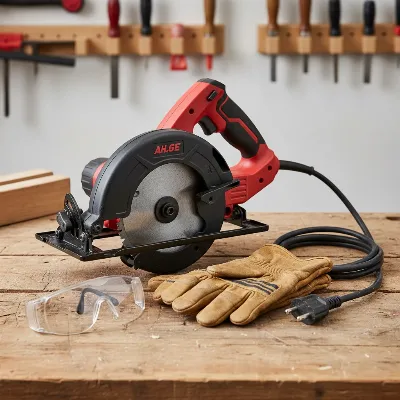 Circular saw unplugged on a workbench, with work gloves and safety glasses nearby, emphasizing safety.
Engage the Arbor Lock
Locate the spindle lock button on your circular saw, typically found near the upper blade guard or motor housing. Press and hold this button down. While holding the button, slowly rotate the saw blade by hand until you feel the spindle lock engage, preventing the blade from spinning freely. This lock is crucial as it keeps the blade stationary while you apply torque to the arbor nut. If your saw doesn’t have a spindle lock, you will need to carefully wedge a piece of wood into the blade teeth against the saw’s shoe to keep it from turning during the next step.
Loosen and Remove the Arbor Nut
With the arbor lock engaged, use your arbor wrench or hex key to loosen the arbor nut. Here’s a critical point: the direction to loosen the nut can vary depending on your saw’s design.
- Direct-Drive Saws (most common, blade on the right): These saws typically have a nut that loosens by turning it clockwise. This might seem counter-intuitive, but it’s designed this way so the cutting action naturally tightens the nut.
- Worm-Drive Saws (blade on the left, often professional models): These saws usually loosen by turning the nut counter-clockwise.
If unsure, check your saw’s manual. Once the nut is loose, fully unscrew it and carefully remove it along with the outer washer or retaining flange. Keep these small parts in a safe place so they don’t get lost.
Carefully Remove the Old Blade
Once the arbor nut and washer are off, you can retract the lower blade guard by hand (it’s spring-loaded) to fully expose the old blade. Carefully lift the old blade off the arbor shaft. Be mindful of its sharp teeth, even if dull, and place it in a safe location for disposal or sharpening.
Install the New Blade Correctly
Now, take your new blade and carefully slide it onto the arbor shaft. This is where blade orientation is paramount. The teeth of the blade must point in the direction of the saw’s rotation, which is typically downwards towards the front of the saw’s base plate. Most blades and saw guards have an arrow indicating the correct rotational direction. Double-check this to ensure proper cutting and safety. After positioning the new blade, replace the outer washer or retaining flange, ensuring it sits correctly on the arbor. Then, screw the arbor nut back on, turning it counter-clockwise for direct-drive saws or clockwise for worm-drive saws, until it’s finger-tight.
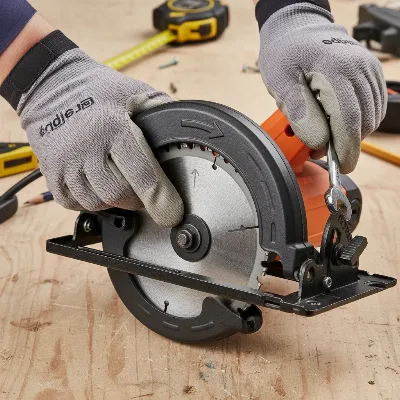 A new circular saw blade being installed, with the teeth direction clearly visible, emphasizing correct orientation.
Final Checks and Testing
With the new blade in place and the arbor lock still engaged, use your wrench to firmly tighten the arbor nut. Do not over-tighten, as the saw’s cutting action will naturally apply additional torque to secure it further. Once tightened, release the arbor lock, gently wiggle the blade to ensure it’s secure and doesn’t wobble, and then spin it by hand to confirm it clears all guards and components without obstruction. Finally, reconnect the power source (plug in the cord or reinsert the battery), and perform a brief test spin away from your body to ensure everything is functioning correctly before making your first cut.
Understanding Blade Types and Selection
Choosing the right blade is as important as changing it correctly. Circular saw blades are designed for specific materials and cut types.
- Tooth Count: More teeth (e.g., 60-80 teeth) result in finer, smoother cuts, ideal for plywood, laminates, and finish work. Fewer teeth (e.g., 24-40 teeth) are better for faster, rougher cuts in framing lumber or demolition.
- Blade Material: Carbide-tipped blades are highly durable and stay sharper longer than steel blades, making them suitable for everyday use and harder materials.
- Material-Specific Blades: There are specialized blades for cutting metal, plastic, masonry, and even fiber cement, each with unique tooth geometries and materials designed for optimal performance and safety with those substances. Always ensure your chosen blade’s RPM rating meets or exceeds your saw’s maximum RPM.
Common Pitfalls and How to Avoid Them
Even with a clear guide, it’s easy to make mistakes. Be aware of these common pitfalls:
- Forgetting to Disconnect Power: This is the most dangerous mistake. Always assume the saw is live until you’ve physically disconnected it.
- Incorrect Blade Direction: Installing the blade backward will not only result in poor cuts but can also be incredibly dangerous, causing kickback and excessive strain on the saw. Always check the rotation arrow.
- Over-tightening or Under-tightening the Arbor Nut: An over-tightened nut can warp the blade or damage the saw’s arbor, while an under-tightened nut can lead to the blade loosening during operation, a serious hazard. Aim for firm, hand-tightening with the wrench, letting the saw’s operation do the rest.
- Using Damaged Blades: Never try to reuse a blade with cracks, bent teeth, or missing carbide tips. These blades are unstable and can shatter during use.
Changing your circular saw blade safely and correctly is a fundamental skill that empowers you to tackle a wider range of projects with confidence and precision. By adhering to strict safety protocols, using the right tools, and understanding the nuances of blade installation, you ensure both the longevity of your equipment and, more importantly, your personal safety. A sharp blade is not just about better cuts; it’s about a safer, more enjoyable woodworking experience. So, take the time to learn this essential maintenance task – your projects and your safety will thank you for it.
Frequently Asked Questions
How often should I change my circular saw blade?
The frequency of changing your circular saw blade depends largely on usage and the materials being cut. For occasional DIY use with softwoods, a blade might last for months. Heavy use or cutting dense materials like hardwoods, engineered wood, or even plastics will dull a blade much faster, potentially requiring replacement every few weeks or after a large project. Signs of a dull blade include smoking wood, difficulty cutting, rough edges, and excessive splintering.
What if my circular saw doesn’t have a spindle lock?
If your circular saw lacks a spindle lock button, you can still safely change the blade. Position the saw on a stable surface with the blade guard retracted. Then, wedge a sturdy piece of wood against the blade teeth to prevent it from rotating while you loosen and tighten the arbor nut with your wrench. Ensure the wood is held firmly and that your hands are clear of the blade’s path.
What does “blade direction” mean for installation?
“Blade direction” refers to the orientation of the saw blade’s teeth relative to the saw’s rotation. For safe and effective cutting, the teeth must point downwards and towards the front of the saw’s base plate, following the direction of the arrow typically stamped on the blade or the saw’s upper guard. Installing the blade backward can cause dangerous kickback, poor cuts, and stress on the saw’s motor.
Can I sharpen a dull circular saw blade at home?
While some specialty services offer professional blade sharpening, sharpening a carbide-tipped circular saw blade at home is generally not recommended for the average user. It requires specific tools, precise angles, and expertise to ensure the blade is balanced and sharpened correctly. Improper sharpening can damage the blade, compromise its safety, and lead to poor cutting performance. It’s usually more cost-effective and safer to replace a dull blade with a new one.
